
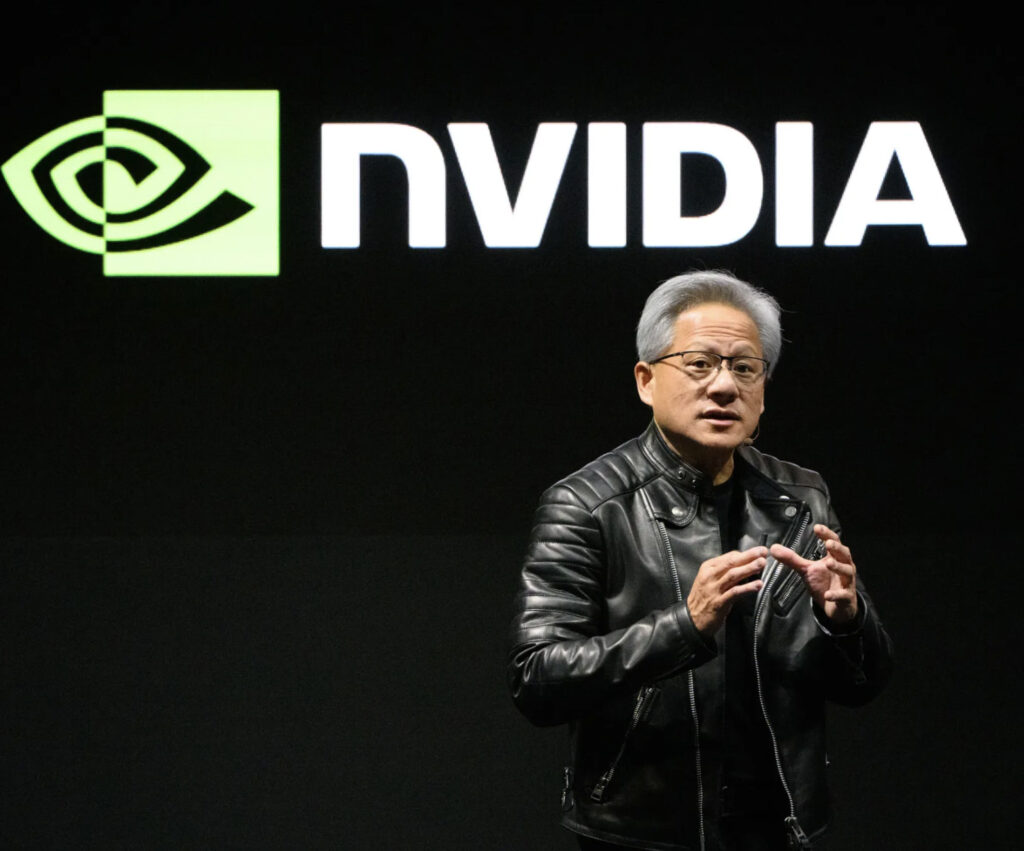
Nvidia has surged past a $4 trillion market capitalization, becoming the world’s most valuable publicly traded company—and analysts suggest this is only the beginning of its growth trajectory. Powered by insatiable demand for AI compute, data center expansion, and its unrivaled dominance in GPU architecture, Nvidia is now at the heart of the global technology stack.
The company’s valuation has more than tripled in under two years, fueled by its pivotal role in powering generative AI applications, large language models, autonomous systems, and accelerated computing for enterprises and governments worldwide. With no clear rival in sight and demand outpacing supply across nearly all segments, Nvidia is no longer just a chipmaker—it’s the engine behind the AI economy.
A $4 trillion market cap is historic, but Nvidia’s strategic positioning and expanding software footprint suggest that ceiling has not
yet been reached.
AI DEMAND PUSHES NVIDIA INTO STRATEGIC MONOPOLY TERRITORY
Nvidia’s growth has been supercharged by the rapid adoption of generative AI and large-scale model training, which require immense parallel processing capabilities. Its H100 and B200 chips remain the industry standard for AI workloads, with hyperscalers like Microsoft, Amazon, Meta, and Google all racing to secure Nvidia hardware to support their expanding AI infrastructure.
The scarcity of advanced chips and Nvidia’s full-stack ecosystem—from CUDA software to networking and server design—has created a strategic moat. While rivals like AMD and Intel are developing competing accelerators, Nvidia continues to dominate on both performance and developer tooling.
Demand for GPUs isn’t just tied to training. AI inference, real-time services, enterprise deployment, and edge processing are all expanding GPU usage far beyond the cloud, embedding Nvidia even deeper into global compute infrastructure.
Nvidia’s AI Enterprise suite, Omniverse platform, and embedded software for autonomous driving and robotics are designed to turn onetime hardware sales into recurring revenue streams. This shift toward a software-defined GPU economy helps explain why the company’s gross margins continue to rise, even as competitors lower chip pricing to stay relevant.
The result is a company that earns not just from selling chips, but from powering the development, deployment, and monetization of AI solutions across nearly every sector.
GROWTH BEYOND TECH: SOVEREIGN AI AND GLOBAL EXPANSION
Nvidia’s influence is no longer limited to Silicon Valley. Nations are investing in sovereign AI infrastructure, and Nvidia is supplying much of the technology behind these efforts. The company has partnered with countries including Japan, Singapore, and Saudi Arabia to build AI supercomputing centers, often co-developed with local universities and defense agencies.
This expansion opens new revenue channels, particularly in regions where public and private sector investment in AI is accelerating.
Emerging markets, in particular, are expected to contribute significantly to Nvidia’s next wave of growth as infrastructure spending catches up to digital demand.
In parallel, Nvidia is scaling its foundry relationships and vertically integrating more of its supply chain to maintain production velocity amid global semiconductor constraints. The company has also increased its AI research spending, positioning itself not only as a vendor but as a leader in foundational model innovation.
$4 TRILLION IS A MILESTONE—NOT A FINISH LINE
Nvidia’s ascent past a $4 trillion market cap puts it in rare company, but analysts and investors view the milestone as a midpoint rather than a peak. The company’s unique role in AI infrastructure, combined with expanding software margins and global strategic relevance, gives it a long-term growth narrative few others can match. As industries realign around AI, and as compute
becomes the currency of future economies, Nvidia’s grip on accelerated processing could tighten even further. The question isn’t whether Nvidia has room to grow—it’s whether anyone can catch up before the next trillion is added.
Leave a Reply
You must be logged in to post a comment.